Choosing tools for your car detailing studio can be confusing. A right car polisher is one of your most important tools. It can make your work faster and give amazing results. But the wrong car polisher can waste your time and even damage a car’s paint.
The right machine can dramatically improve paint correction results, reduce labour time, and boost customer satisfaction. On the other hand, choosing the wrong one can lead to swirl marks, operator fatigue, and costly rework.
Many new detailers make mistakes. They buy the cheapest machine or the most expensive one without knowing how to use it. Choosing the wrong machine can damage the customer’s car or make your hands hurt after a long day.
This guide is for you. We will talk in simple language about how to pick the perfect polisher machine for your detailing business.
What is a Car Polisher?
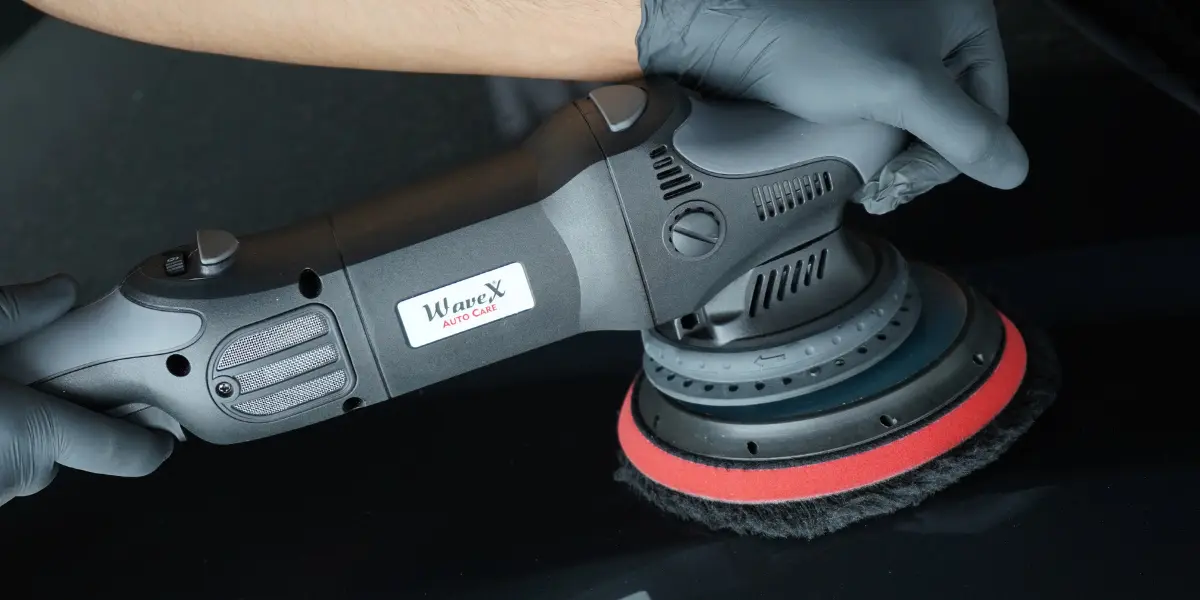
A car polisher is a machine that helps you polish and buff car paint to remove light scratches, swirl marks, water spots, and oxidation while improving gloss and clarity.
It makes the car’s surface smooth and shiny. Using a car polisher is much faster and gives better results than polishing by hand.
Polishing by hand takes significantly longer (often double the time, around 4-10+ hours) and requires more physical effort, while a machine polisher cuts the time down to 1-4 hours for an average car, depending heavily on paint condition, car size, and desired correction level, with machines being faster and more effective.
Unlike hand polishing, machine polishing delivers consistent pressure and motion, producing professional-level results in far less time.
Why Do You Need a Car Polisher in Your Detailing Shop?
Based on our experience working with professional detailers across India, here are the main benefits:
- Saves Time: A car polisher can complete in 2 hours what would take 6-8 hours by hand.
- Better Results: Machines give more consistent and professional results than manual polishing.
- Less Physical Effort: Your staff will not get tired quickly, which means they can work on more cars each day.
- More Money: With faster work and better quality, you can serve more customers and charge premium prices.
Why is the Right Car Polisher So Important?
Think of a car polisher like a painter’s brush. A good brush makes smooth strokes. A bad brush leaves streaks. Similarly, a good car polisher helps you:
- Remove scratches and swirl marks.
- Bring out a deep, mirror-like shine.
- Save time and physical effort.
- Make your customers very, very happy.

Types of Car Polishers: Know the Difference
There are mainly two types you should know about:
1. Dual Action (DA) / Random Orbital Polisher
What it is: The polishing pad moves in small circles AND rotates. This is a safe and friendly machine.
Best for: Beginners, most detailing shops, and safe paint correction. It is very hard to damage the paint with this car polisher. It is our top recommendation for most detailers starting out.
Popular Brands: ShineMate, RUPES, MaxShine, Bosch.
2. Rotary Polisher
What it is: The polishing pad only spins in one fast, strong circle.
Best for: Experts with lots of practice. It can correct severe defects very fast. But it can also burn the paint if the detailer is not skilled.
Popular Brands: ShineMate, Makita, Flex.
6 Things to Check Before Buying a Car Polisher
Here is your buying checklist:
1. Power (Watts or Volts):
More power means the machine keeps spinning strong even when you press it against the paint. Look for a car polisher with good power (e.g., 900-1200 Watts for corded models). Weak polishers will stop when pressure is applied.
- Minimum 600 watts for dual-action polishers
- 900-1200 watts for rotary polishers
2. Speed Settings:
You need different speeds for different jobs (like applying polish vs. final finishing). A good car polisher will have variable speed control (from low speed 1 to high speed 6).
A good car polisher must have a speed dial.
- You need a low speed for spreading the compound.
- You need high speed for cutting and polishing.
- Ensure the switch is easy to reach with your thumb while working.
3. Weight and Comfort:
You will hold this machine for hours. A lighter car polisher reduces hand and arm pain. Check if the handle feels comfortable. Your staff’s health is important.
You will hold this machine for 4 to 5 hours a day.
- If the car polisher is too heavy, your shoulders will be in pain.
- If it vibrates (shakes) too much, your fingers will feel numb.
- Tip: Always hold the machine in your hand before buying. A lighter machine is usually better for the Indian weather, where we sweat a lot.
4. Brand and Service:
Buy from a known brand. A trusted brand means better quality and longer life. Also, check: Is service or repair available in your city? Can you easily buy spare parts like backing plates?
In India, there are Chinese brands and premium brands like ShineMate.
- Budget Options: Good for starting. However, they may vibrate more and have a shorter warranty.
- Premium Options: They are expensive, but they are very smooth and last for years.
- Tip: Invest in brands known for professional-grade tools. Reputable manufacturers design polishers that withstand daily use and offer better warranties and service support.
5. Corded vs. Cordless:
Corded: Usually more powerful, never runs out of battery. Best for shop use.
Cordless: Very convenient, no wire tangling. Good for quick jobs or if you have power cuts. But it is often more expensive and less powerful.
Corded Models
- Consistent power output
- Ideal for shop-based detailing
- Generally, more affordable
Cordless Models
- Maximum mobility
- Great for mobile detailing
- Battery life must be considered
6. Pad Size Compatibility:
Most professional shops use 5-inch or 6-inch backing plates. A versatile Car Polisher should support multiple pad sizes for different vehicle panels.
The backing plate is where you stick the foam pad.
- 5-inch and 6-inch plates are standard for the bonnet and doors.
- 3-inch plates are needed for small areas like bumpers and mirrors.
- Ideally, the studio should have one big car polisher and one small mini-polisher.